
Contractors discuss how steady work affects the bottom line
By Susan DeGrane
Is steady bread-and-butter work a thing of the past? Is it possible to count on basic local wiring jobs as a mainstay? Two family-owned contractors in California shared the origins of trends in the electrical industry.
Collins Electrical Co. Inc.
“There’s plenty of bread-and-butter work out there, but these days it’s not all cut from the same loaf,” said Brian Gini, co-CEO for Collins Electrical Co. Inc., Stockton, Calif. “There are lots of slices from lots of different types of bread.”
Gini and his two brothers, Craig and Kevin, own and operate the 100-year-old firm along with their parents, Eugene Gini, chairman of the board, and Dianne Gini, senior vice president.
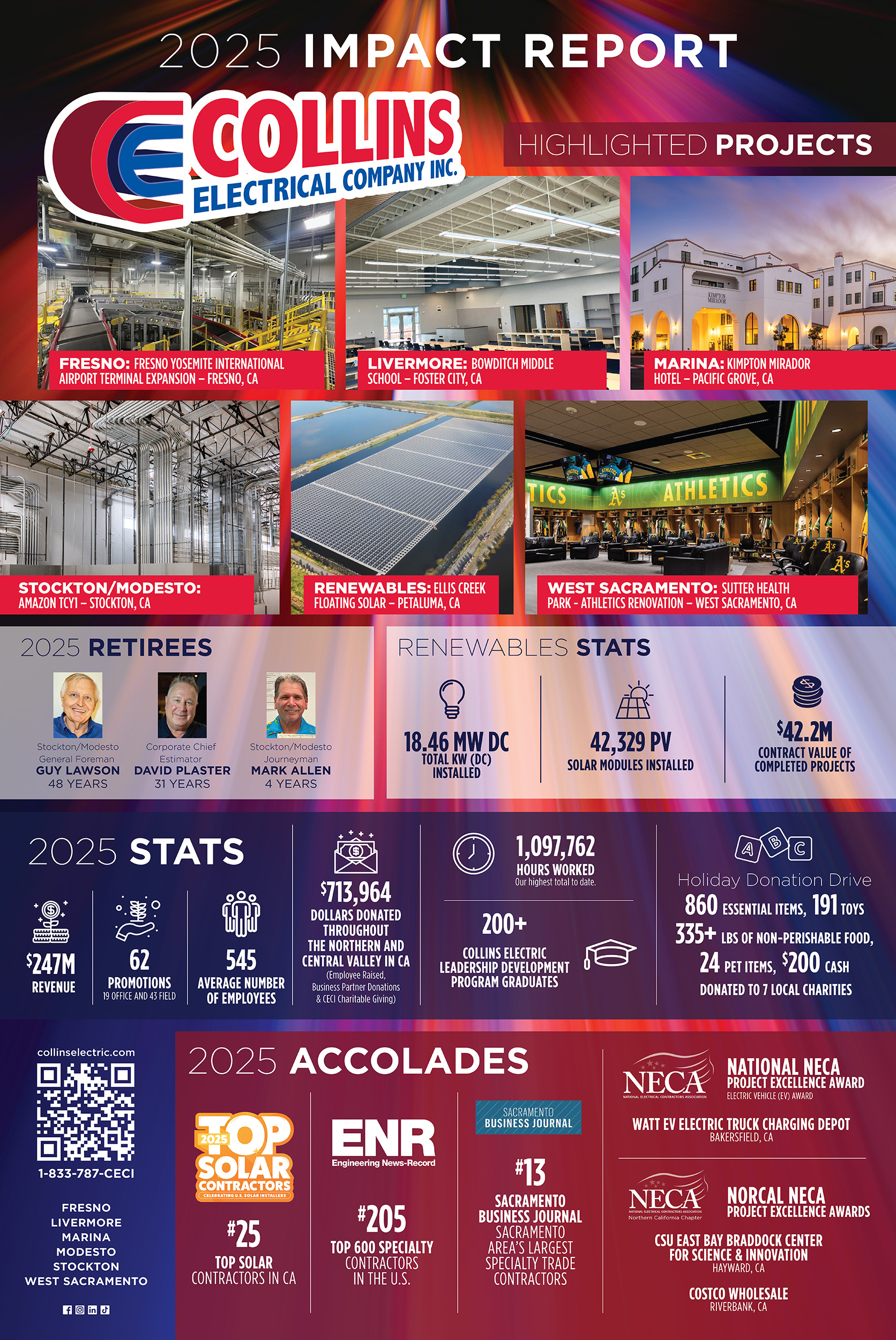
Founded in 1924, Collins Electrical completed its first major project in 1929—State Hospital in Stockton. More hospital projects followed, and so did work on Hoover Dam.
In 1936, Collins Electrical noted a huge victory when the dam’s first turbine started generating electricity from the Colorado River. As a subcontractor, Collins Electrical wired connections from the dam’s generators to transmission lines connecting with utilities serving Nevada, Arizona and California.
Like many Collins Electrical projects, Hoover Dam, as a power generator, took the title of “the largest in the nation at the time.” But Collins Electrical also has thrived on bread-and-butter projects and maintenance contracts familiar to most contractors—schools and businesses, industrial projects, street lighting, warehouses, a zoo, an aquarium, hotels, casinos, sports arenas and water reclamation projects.
The company, with offices in Fresno, Livermore, Marina and West Sacramento, Calif., has forged long-standing relationships and aims for work within a 1.5-hour travel radius of each office.
Local focus, diversified talent
“Rather than being the contractor that travels to go after one type of work, we go after all the work that comes into our space,” Brian Gini said. “Twenty years ago, all we did was go out hunting elephants, large projects. But we learned over time that we’ve needed to diversify, so when one market drops off in our area and another one picks up, we have the broad array of talent and training to cover all those types of markets.”
Diversification of talent works well for the company’s bottom line and employees. The average Collins Electrical employee has been with the company for 15 years.

“We want to make sure our employees can handle anything from a water treatment plant to a high school to a portable classroom, to hospitals,” Brian Gini said. “We try to train our apprentices under our company culture, which values individual talent. If an employee shows leadership skills, we may move them into a formal position as a field superintendent. That ensures we have a full cadre of talent for different projects.”
Collins Electrical still goes after plenty of large projects, but these tend to be local to enable pooling resources and specialties from the various Collins locations.
One way Collins Electrical has managed to prosper amid shifting local markets is by not clinging too tightly to EV charging work after having experienced success installing large projects.
The company still handles this work, but opportunities are less plentiful in Northern California due to concerns over the grid’s ability to support EVs and energy-hungry data centers as well as the electrification of sectors once supported by fossil fuels. Instead, Collins Electrical decided to focus and build on its expertise in green energy power generation and storage.
Collins Electrical established its solar division in 2009, and it remains a major solar player even with more contractors entering the market, thanks to specialization in “floatovoltaics,” or floating photovoltaics—solar arrays that float near dams and on lakes and retention ponds.
“This works well where land is at a premium, and it has many side benefits,” said Craig Gini, senior vice president and chief transformation officer. “The solar panels prevent evaporation, and they even discourage algae growth because they block sunlight, and algae needs sunlight to grow.”
Among the more than 450 solar photovoltaic projects Collins Electrical has completed, the Healdsburg Wastewater Treatment Plant with its 4.7-megawatt (MW) DC floating solar photovoltaic system was “the largest in the nation” when completed in May 2021.
And it can still be considered among the most innovative. To fulfill the owner’s requirement that the pond liners be inspected every five years, Collins Electrical designed the system so the arrays could be decoupled and repositioned to allow the owners to drain the ponds for inspection. Even during anticipated downtime, the system can produce power.
Collins Electrical has since completed additional solar projects with more to come.
While solar represents about 18%–20% of the company’s business mix, service and special projects represent about 30%. The remainder is what the brothers call “soft negotiations and hard-bid projects involving commercial and industrial work.”
“Our design-build employees have experience in the field and cut out the top layer,” said Kevin Gini, co-CEO. “They keep the best functionality in mind, working toward a truer price. You want the guys in the field to help you mitigate that stuff. That’s why our people have to be a part of the process. Our best practices and first-hand knowledge help the bottom line.”
“The value we bring to owners is expertise from the field,” Brian Gini said. “We’ll have our design-build team scrub the engineer’s design for best practices and best value.”
Design-build services, which entail collaboration with customers often before the bidding starts, are growing in popularity and a growing portion of Collins Electrical’s business mix.
“The primary point of design-build is to be good with the customer and listen,” Kevin Gini said. “It really takes back-and-forth conversation to understand what they want and to be able to visualize and know how this and that are going to happen.”
Employee education
Crucial to supporting the customer is having the design-build team, estimating, and design teams all work together, Kevin Gini said. Supporting employee education is also key.
Members of Collins Electrical’s team have certifications from the Design-Build Institute of America. Many of these same folks also have LEED certifications from the U.S. Green Building Council. The company overall subscribes to LEAN building practices, which support mutual respect, trust and collaboration.
“We have become a go-to company for negotiated conceptual design-build type projects that will have a hard bid later on, but people come to us because we have the ability to work together to get jobs done,” Brian Gini said.
Partnering
Collins Electrical frequently partners with other contractors that might be otherwise regarded as competitors. This practice has become necessary for handling bread-and-butter projects, which tend to be larger than in years past. Partnering in today’s business climate also has come to distinguish many of the most successful contractors.
For the transformation of Sutter Health Park, a ballpark in West Sacramento, Calif., Collins Electrical performed design-build construction and partnered with Valley Communications Inc. of Sacramento, which served as a systems integrator for the park’s technology.
Collins Electrical recently completed a 3.4-million-square-foot data center after signing on two other electrical contractors. For a large hospital project, casino project and large data center, the company is partnering with others.
Partnering helps to stretch manpower and expand necessary capital.
“We don’t want to take on too much liability and risk, so we take on friendly competitors. And they are competitors,” Brian Gini said. “We will compete to the end, but we will also help each other build projects as well.”
For handling bread-and-butter work, Collins Electrical also partners with an assortment of electrical mechanical designers and engineers as well as other trades.